Rephrase AI vs Scribbr: Which Paraphrasing Tool Is Better?
Compare Rephrase AI and Scribbr on output, input limits, no-signup access, pricing, and workflow to choose the right paraphrasing tool online.

Rephrase AI is the better fit when you need a larger public input and a cleaner captured secondary result. Scribbr's paraphrasing tool is the better fit for unlimited short-text use without signup. Scribbr officially says its AI Paraphrasing Tool is powered by QuillBot; this comparison relies on that disclosure rather than making a separate claim about an undisclosed backend.
Rephrase AI vs Scribbr at a glance
| Decision point | Rephrase AI | Scribbr |
|---|---|---|
| Public request limit | 1,200 characters per request | Up to 125 words per input |
| Access | Public preview; Free plan has three standard rephrases per month after sign-in | Anonymous public tool with no signup for short text |
| Captured default mode | Clearer produced a complete rewrite | Standard made a broader rewrite |
| Captured secondary mode | Professional stayed polished and complete | Fluency included “regular opportunity” in this run |
| Best fit | Longer short-form passages and focused revision | Repeated, no-signup short-text paraphrasing |
How we tested
We compared each tool using current official product pages and documentation, focusing on workflow, access, pricing, and everyday usefulness. Paid, login-only, and technical requirements are noted where they affect our recommendation.
Rephrase AI publishes this comparison and evaluates its own product. We show the raw outputs so readers can assess the evidence, and we do not claim this review is neutral.
On August 10, 2026, we entered the same 51-word remote-work passage into Rephrase AI's public workflow in Clearer and Professional modes. We then ran Scribbr anonymously in Standard and Fluency modes with English (US). We evaluated preservation of the source ideas, rewrite depth, grammar, tone, public access, limits, and pricing. The results are dated single-run observations, not a guarantee of future output.
Rephrase AI benchmark result
Rephrase AI Clearer kept the source's recommendation while turning it into a complete, polished rephrase:
Remote work has transformed team communication. While employees can concentrate without office distractions, they might find it challenging to form relationships with colleagues. Companies should establish clear communication practices, document key decisions, and provide regular chances for team members to connect. A careful strategy enables distributed teams to remain productive while fostering collaboration.
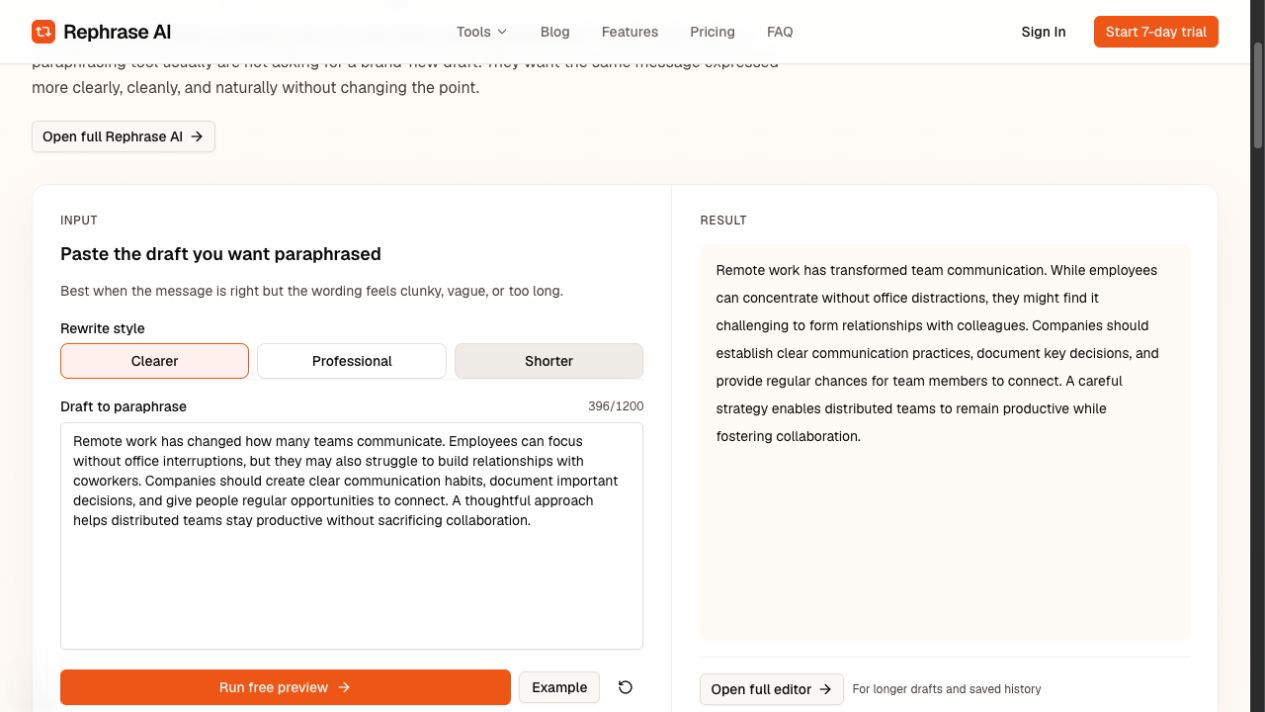
Rephrase AI Clearer benchmark showing the rewritten remote-work passage.
The captured Professional mode was more formal while preserving the same practical advice:
Remote work has transformed communication dynamics within many teams. While employees can concentrate without the distractions of an office environment, they may encounter challenges in fostering relationships with their colleagues. Organizations should establish clear communication practices, document significant decisions, and provide regular opportunities for team members to connect. A strategic approach enables distributed teams to maintain productivity while enhancing collaboration.
Scribbr benchmark result
Scribbr's anonymous Standard result made a significant rephrase:
Many teams now communicate differently as a result of remote work. Without office distractions, workers can concentrate, but they might find it difficult to form bonds with their coworkers. Businesses should establish transparent communication practices, record significant decisions, and provide frequent chances for interaction. Distributed teams can maintain productivity without compromising teamwork by taking a deliberate approach.
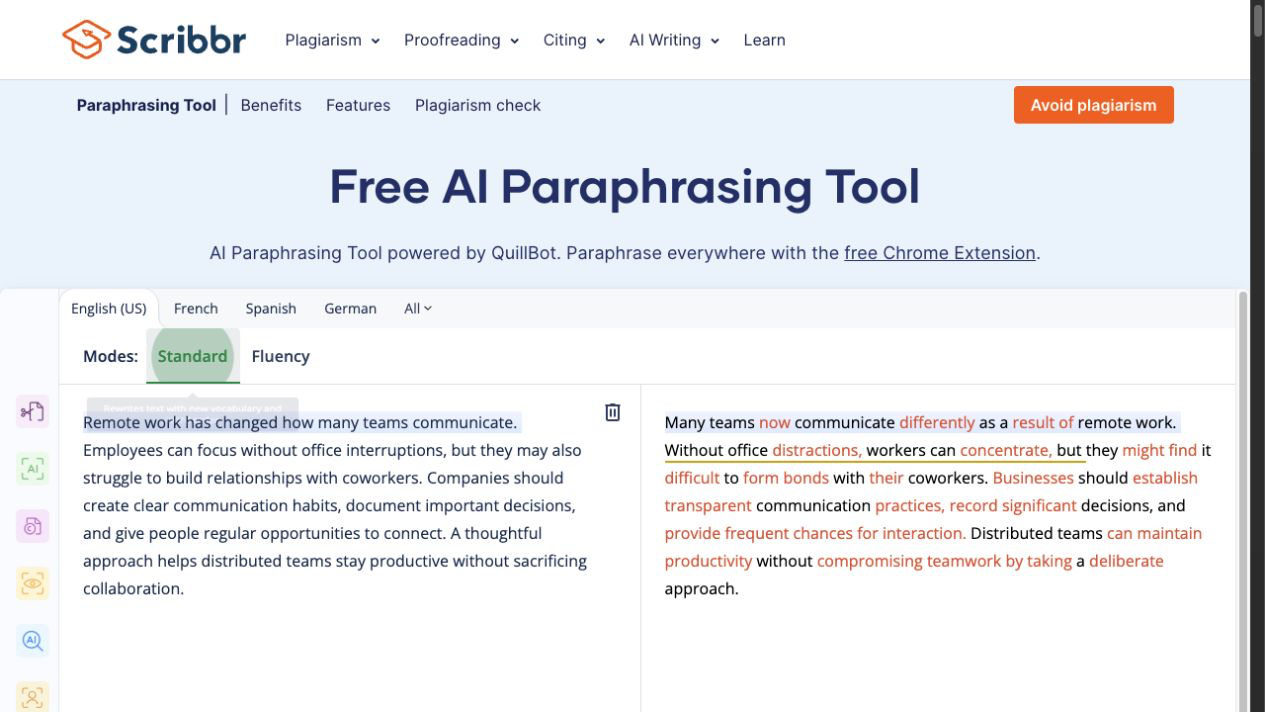
Scribbr Standard benchmark showing the anonymous paraphrase result.
The captured Fluency result was closer to the source, but it included the singular phrase “regular opportunity”:
Remote employment has altered the way many teams communicate. Employees can focus without office distractions, yet they may struggle to form relationships with coworkers. Companies should establish clear communication practices, document key decisions, and provide regular opportunity for people to connect. A careful approach enables distant teams to remain productive without compromising collaboration.
Scribbr's technology disclosure says the AI Paraphrasing Tool is powered by QuillBot. That is the basis for identifying the relationship here; no broader technical inference is needed.
Output quality and workflow comparison
Rephrase AI is the better match in this captured test for a longer short-form request and a clean secondary option. Its public preview accepts 1,200 characters, which is materially larger than Scribbr's stated 125-word passage cap, and Professional avoided the singular wording issue observed in Scribbr Fluency.
Scribbr's advantage is low friction. Its anonymous public tool is designed for unlimited short-text use without signup, and it plainly discloses the QuillBot technology relationship. That is useful for someone who needs to rephrase several short passages without creating an account.
The trade-off is that Rephrase AI's signed-in Free plan is limited to three standard rephrases per month instead of Scribbr's per-input public limit. Whatever tool you use, review names, conditions, citations, and the intended level of certainty before using a rephrase in consequential writing.
Free limits and pricing
Rephrase AI's public preview allowed up to 1,200 characters per request on the test date. Its signed-in Free plan included three standard rephrases per month.
Rephrase AI Pro costs $29/month, or $17.42/month with annual billing. Billed $209 annually.
Scribbr's public paraphrasing tool said passages can be up to 125 words per input. No separate Scribbr plan price was captured for this public tool, so this comparison does not invent one. The access advantage is anonymous, no-signup use for short passages, subject to the displayed per-input limit.
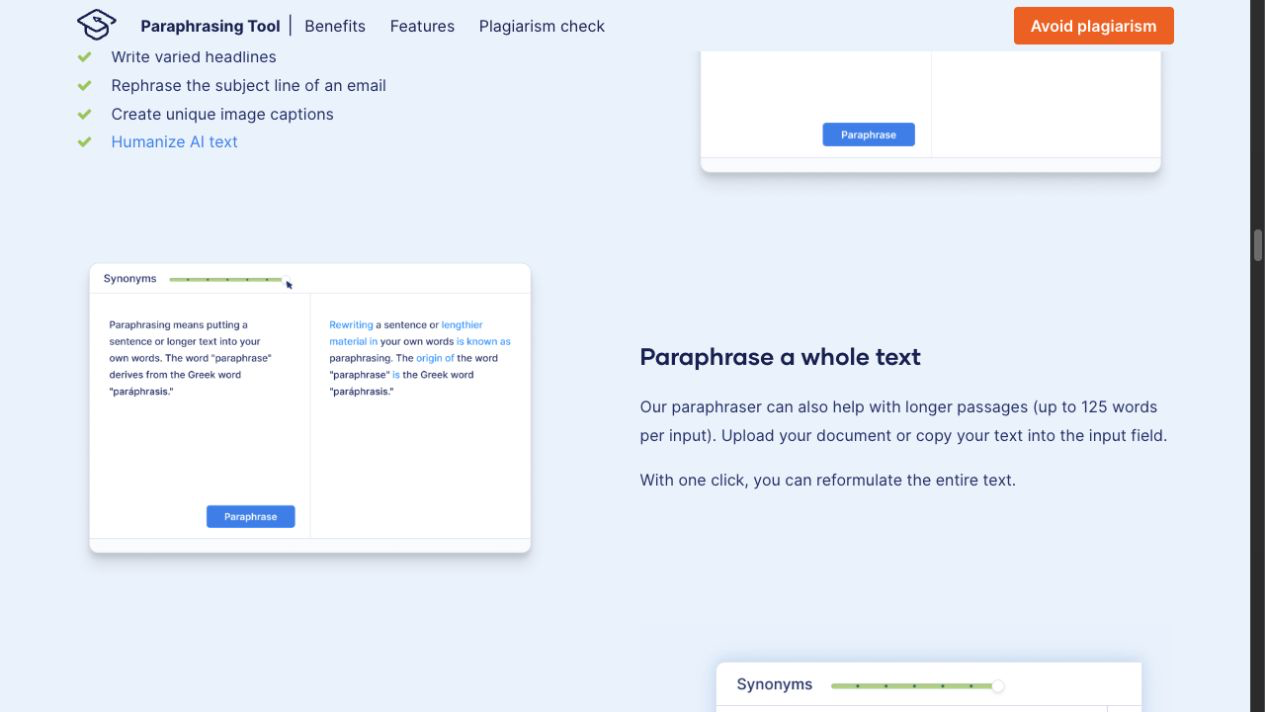
Scribbr interface showing the 125-word passage limit.
Which tool should you choose?
Choose Rephrase AI if you want to handle a larger short-form input in one public request or want a Professional rephrase that was cleaner than the Scribbr Fluency result in this benchmark. It is a practical choice for an email draft, paragraph, or concise update that needs a deliberate tone.
Choose Scribbr if you need no-signup, unlimited use for repeated short passages and can work within its 125-word input limit. Its public tool is especially convenient when account creation would get in the way of a quick rephrase.
Pros and cons
Rephrase AI
Pros
- Public preview accepted up to 1,200 characters per request.
- Clearer and Professional produced complete benchmark rewrites.
- Professional avoided the singular “regular opportunity” issue seen in Scribbr Fluency.
Cons
- The signed-in Free plan permits three standard rephrases per month.
- It is less convenient than Scribbr for unlimited short-text use without signup.
Scribbr
Pros
- Anonymous public access supports unlimited short-text use without signup.
- The tool clearly states that it is powered by QuillBot.
- Standard made a substantial rephrase in the captured run.
Cons
- Passages are limited to 125 words per input.
- The captured Fluency output used singular “regular opportunity,” which calls for review.
FAQ
Rephrase a longer short draft
Rephrase a short draft, then compare the result with your original to check the meaning, tone, and details before using it.