Rephrase AI vs Rephrasely: Which Rephrasing Tool Is Better?
Compare Rephrase AI and Rephrasely on benchmark output, meaning preservation, modes, language options, free limits, and August 2026 pricing.

Rephrase AI is the better pick when you need a controlled rewrite that keeps a work-focused paragraph close to its source meaning. Rephrasely is the better pick when a broad mode menu and translation options matter more than a tightly constrained rewrite. In our August 10, 2026 benchmark, Rephrasely Standard became notably more colloquial, while Smooth became more expansive and formal.
Rephrase AI vs Rephrasely at a glance
| Decision factor | Rephrase AI | Rephrasely |
|---|---|---|
| Best for | Controlled, professional wording | Exploring many rewrite styles and languages |
| Captured public input limit | 1,200 characters | 3,000 characters anonymously; 10,000 with a free account |
| Visible styles or modes | Three displayed rewrite styles | 22 visible modes in the live menu |
| Free-plan trade-off | Three standard rephrases per month after sign-in | Larger public input, but plan and mode copy conflict |
| Paid pricing | $29/month, or $17.42/month with annual billing. Billed $209 annually | $12.99/month, or $4.99/month billed annually ($59.88 every 12 months) |
Rephrase AI prices reflect current plans. Competitor prices in the table were captured on August 10, 2026.
How we tested
Rephrase AI publishes this comparison. On August 10, 2026, we ran the same 51-word remote-work passage through each publicly available tool, first with the displayed default and then with a relevant secondary mode. For Rephrase AI, that was Clearer and Professional; for Rephrasely, Standard and Smooth in English using the displayed RephraseAI model and variation setting.
This is a dated, single-run observation rather than a promise that either tool will always return the same wording. We looked at meaning preservation, the amount and kind of rewriting, clarity, tone, access, limits, and published pricing. The raw outputs below are preserved so you can make your own call.
Rephrase AI benchmark result
In Clearer mode, Rephrase AI kept each source idea while making the wording more direct:
Remote work has transformed team communication. While employees can concentrate without office distractions, they might find it challenging to form relationships with colleagues. Companies should establish clear communication practices, document key decisions, and provide regular chances for team members to connect. A careful strategy enables distributed teams to remain productive while fostering collaboration.
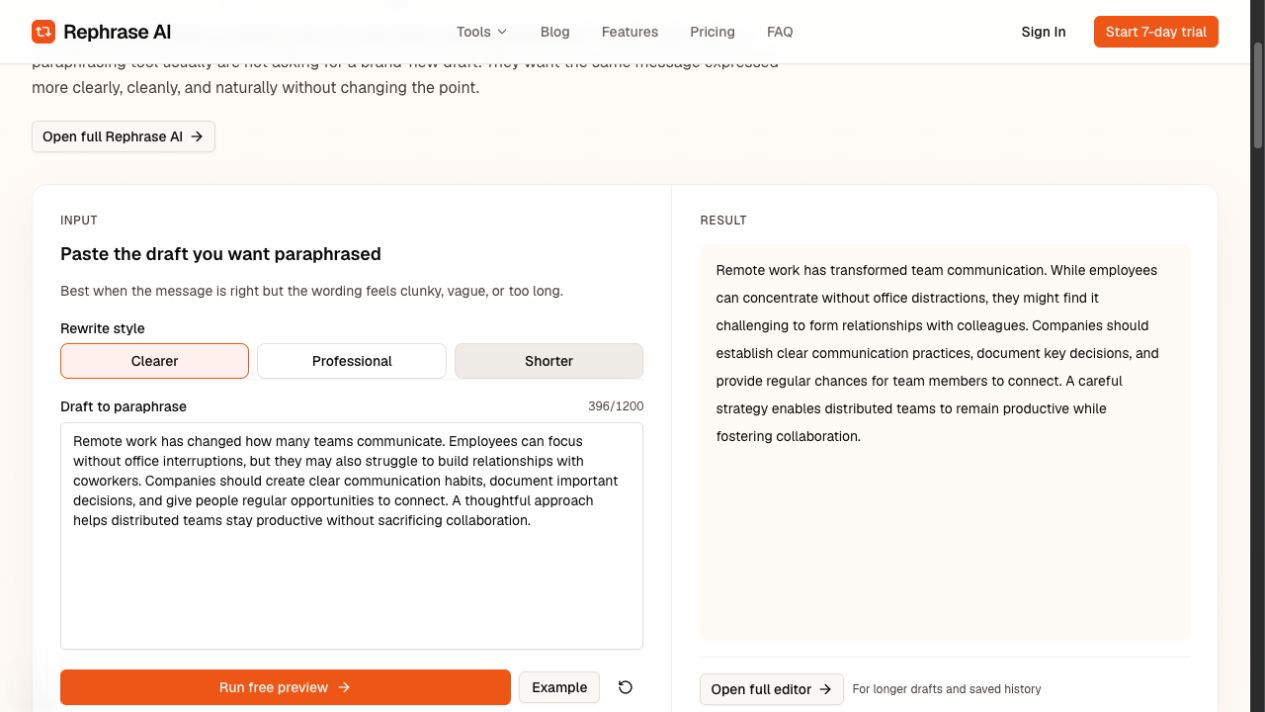
Rephrase AI Clearer benchmark showing the rewritten remote-work passage.
The secondary Professional result was more formal without changing the core recommendation:
Remote work has transformed communication dynamics within many teams. While employees can concentrate without the distractions of an office environment, they may encounter challenges in fostering relationships with their colleagues. Organizations should establish clear communication practices, document significant decisions, and provide regular opportunities for team members to connect. A strategic approach enables distributed teams to maintain productivity while enhancing collaboration.
Rephrasely benchmark result
Rephrasely was available anonymously. Its Standard result chose plainer, more conversational wording:
Working from home has changed how teams talk to each other. People can concentrate better because there are fewer distractions, but it can be harder to make friends at work. Companies should set clear ways for everyone to share information, write down important choices, and give workers chances to talk and share ideas regularly. Thinking carefully about these things helps teams work well together even when they are apart.
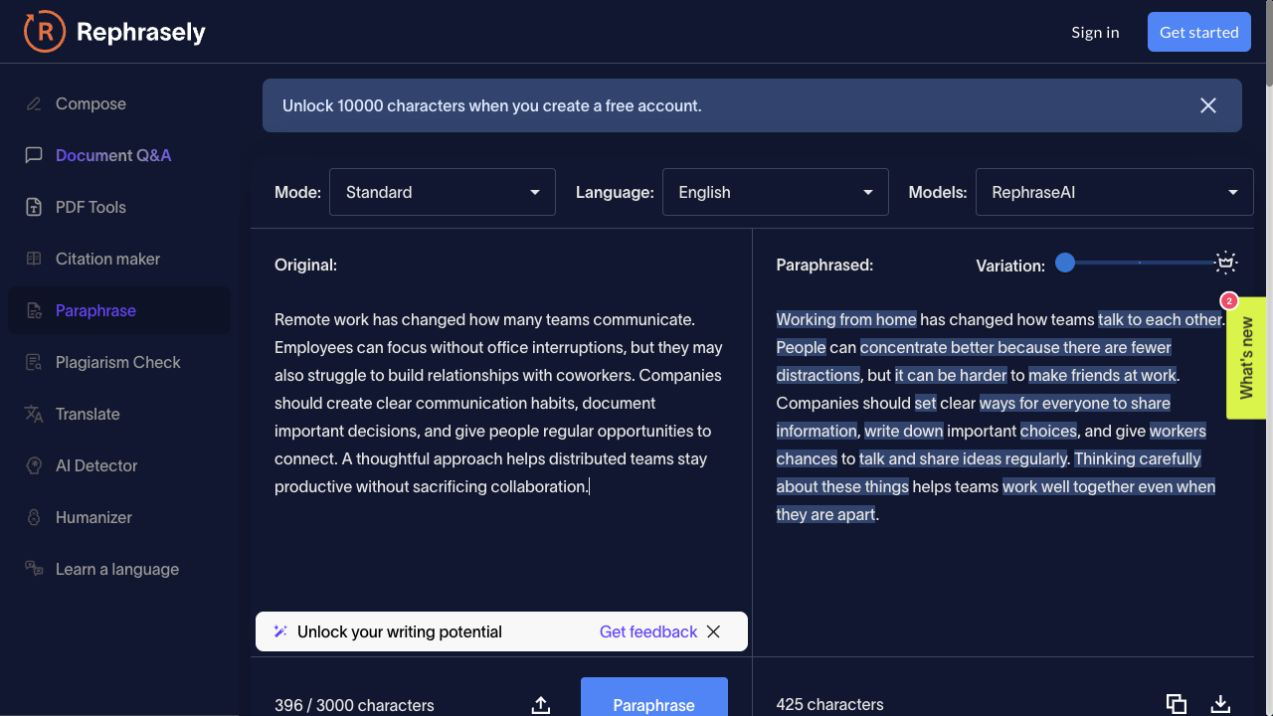
Rephrasely Standard benchmark output from the anonymous public tool.
Smooth moved in the opposite direction, with more formal and expansive wording:
Remote work has transformed the landscape of team communication. While employees benefit from increased focus free from office distractions, forging strong relationships with colleagues can pose a challenge. To navigate this, organizations should establish well-defined communication protocols, meticulously document key decisions, and provide consistent opportunities for meaningful interaction. A strategic and considerate approach ensures that distributed teams remain highly productive while fostering a collaborative and connected environment.
Output quality and workflow comparison
For a reader who wants a polished revision without changing the level of formality too much, Rephrase AI's Clearer result is the stronger fit in this run. It preserves the source's four ideas and stays close enough to review quickly. Rephrasely Standard makes the same overall point, but phrases such as “make friends at work” and “talk and share ideas” make the professional source more casual.
Rephrasely's Smooth result is usable when a more elevated tone is intentional. It also illustrates the trade-off: the rewrite adds more framing, such as “the landscape of team communication” and “a collaborative and connected environment.” That can suit a formal summary, but it gives a reviewer more language to assess for tone and meaning.
Rephrasely has a real workflow advantage. Its live mode menu showed 22 modes—10 free and 12 premium—and its plans advertise translation in 100+ languages. Rephrase AI's public preview instead shows three rewrite styles, so it is not the right choice for someone who needs a large mode catalog. Rephrasely's own nearby copy is inconsistent, though: it also refers to “20 modes” and to “eighteen (12 free and 6 premium) styles.” We are reporting those as conflicting claims, not treating any one of them as a corrected total.
Free limits and pricing
Rephrase AI's public preview allows up to 1,200 characters per request. The signed-in Free plan includes three standard rephrases each month.
Rephrase AI Pro costs $29/month, or $17.42/month with annual billing. Billed $209 annually.
Rephrasely's anonymous counter showed 3,000 characters, and its public tool offered 10,000 characters after creating a free account. Its captured pricing modal listed $12.99 USD/month or $4.99 USD/month billed annually ($59.88 every 12 months). It also listed prepay credits: $5 for 60K words, $10 for 120K words, and $15 for 180K words. Check the current Rephrasely site before buying, especially because the mode totals above conflict on the vendor's pages.
Which tool should you choose?
Choose Rephrase AI if you want to turn a work paragraph into a clearer or more professional version while keeping the message easy to compare with the original. Start with the public paraphrasing tool, then review names, facts, commitments, and tone before using the result.
Choose Rephrasely if you routinely need to experiment with a wide range of styles, need translation in 100+ languages, or want a larger anonymous input allowance. Its mode breadth is the more important advantage here; just verify current plan details on the official page because its published mode totals differ.
Pros and cons
Rephrase AI
Pros
- Clearer produced a controlled, complete rewrite in this benchmark.
- Professional provides a more formal alternative without a large expansion.
- The public preview and signed-in plan limits are clearly distinct.
Cons
- The public preview is limited to 1,200 characters.
- The free plan allows three standard rephrases per month.
- Three displayed rewrite styles are much narrower than Rephrasely's live mode menu.
Rephrasely
Pros
- The live menu exposed 22 modes, including free and premium choices.
- The anonymous run showed a 3,000-character input counter.
- Plans advertise translation in 100+ languages.
Cons
- Standard made the benchmark more colloquial, and Smooth was substantially more expansive.
- Official mode totals conflict between the live menu and nearby copy.
- A broader menu can require more review to keep the intended voice and meaning.
FAQ
Try a clearer version of your draft
Rephrase a short draft, then compare the result with your original to check the meaning, tone, and details before using it.