QuillBot vs Turnitin: What Paraphrasing and Detection Actually Show
Compare QuillBot paraphrasing with Turnitin AI-writing review, including access, input limits, score boundaries, and responsible human review.

QuillBot and Turnitin answer different questions. QuillBot rewrites text; Turnitin reports AI-writing signals for qualifying prose in a licensed academic workflow. Turnitin will not always flag text that has been paraphrased, and a result from either workflow cannot prove authorship or misconduct. A detector result should begin a contextual review, not end it.
Use the same criteria to understand both products: what each workflow does, who can access it, which input limits apply, how its result should be interpreted, and what a person still needs to review.
QuillBot vs Turnitin at a glance
| Decision point | QuillBot | Turnitin |
|---|---|---|
| Main job | Rewrites wording through dedicated paraphrasing modes | Reports AI-writing signals for qualifying prose |
| Access | Public paraphrasing page with Free and Premium boundaries | Institutional license and administrator enablement |
| Input boundary | Free plan accepts up to 125 words in Standard and Fluency | AI Writing Report requires 300–30,000 words of qualifying prose in supported files and languages |
| Result | An alternate version that still needs meaning and grammar review | An AI percentage separate from the Similarity score |
| Best fit | Writers choosing a clearer or differently worded version | Institutions reviewing eligible submissions under their own policy |
Why paraphrasing does not predict a detector result
Paraphrasing changes expression. Detection estimates whether patterns in submitted prose resemble patterns a model associates with AI writing. Those are different operations, so the fact that a passage was rewritten does not determine what Turnitin will report.
Turnitin also evaluates only qualifying prose under documented file, word-count, and language requirements. Even when a report is available, Turnitin says its model can misidentify human or AI text and should not be the sole basis for adverse action. That is why no responsible rule can say a QuillBot rewrite will or will not receive a particular signal.
QuillBot for changing wording
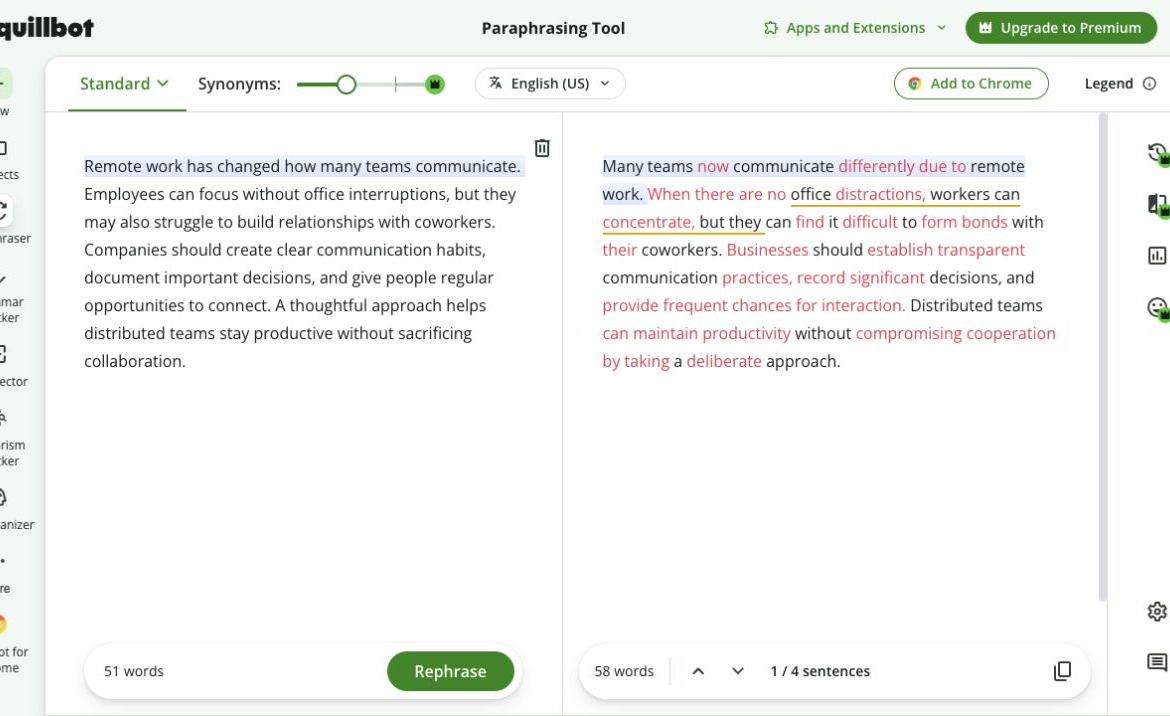
QuillBot's paraphrasing interface showing source and rewritten text side by side.
QuillBot's Paraphrasing Tool is designed to produce alternate wording. Its Free plan handles up to 125 words in Standard and Fluency modes. That focused workflow is useful when the source meaning is sound but the phrasing needs another pass.
In one Standard-mode result, the rewritten passage kept its major recommendations and remained readable, but it also changed some terminology. That is the practical review boundary: compare the result with the source and verify names, numbers, qualifications, citations, and technical meaning.
QuillBot Premium lists unlimited paraphrasing, nine built-in modes, custom modes, mode comparison, history, synonym control, and paraphrasing in 23 languages. It displays $8.33 per month billed annually, so the annual commitment belongs with the price when comparing plans. None of these features promises a particular detector outcome.
Turnitin for institutional review
Turnitin's access guidance says AI Writing Detection must be added to an institution's license, and instructors and users work through their Turnitin administrator. It is not an anonymous public counterpart to QuillBot.
The AI Writing Report guide says a report requires 300 to 30,000 words of qualifying long-form prose, a file below 100 MB, a supported language, and a DOCX, PDF, TXT, or RTF file. Its AI percentage addresses qualifying prose identified as likely AI-generated or AI-modified; it is independent of the Similarity score.
Turnitin's score-display guidance suppresses exact scores and highlights from 1% through 19%, where false positives are more likely. That caution does not make a higher percentage proof. Turnitin calls for scrutiny, human judgment, and the institution's policy rather than adverse action based on the report alone.
How to review a result responsibly
Start by separating the questions. Check a rewrite against its source for meaning, attribution, and factual accuracy. Treat an AI-writing signal as one reason to examine source material, drafting or version history, citations, the writer's explanation, and the assignment context.
Apply the institution's policy consistently and give the writer a fair opportunity to provide context. A lower or higher signal is not proof of originality, assistance, or intent. Human review should weigh the complete record rather than substitute a percentage for judgment.
FAQ
Use a score as a starting point
For a separate, non-conclusive signal on a passage, try the Rephrase AI detector, then complete a contextual human review.