GPTZero vs Turnitin: Which AI Detector Is Accurate?
Compare GPTZero and Turnitin as AI-writing review tools, including access, report limits, and why neither score proves authorship.

No responsible overall accuracy winner is established between GPTZero and Turnitin. Neither score proves authorship or academic misconduct. GPTZero is a public-facing detector with documented scan and reporting features; Turnitin is an institutionally licensed AI Writing Report inside an academic workflow. Use either result as one review signal alongside source material, drafting history, conversation, context, and the applicable policy.
The same criteria apply to both: what the detector is designed to review, how a person can access it, the report or score boundaries the provider documents, and the limits that prevent a fair score comparison.
GPTZero vs Turnitin at a glance
| Decision point | GPTZero | Turnitin |
|---|---|---|
| Access model | Public detector and signed-in web workflow | Institutionally licensed and administrator-enabled report |
| Documented input boundary | Anonymous page shows a 10,000-character limit and 250-character minimum | Qualifying prose must be 300–30,000 words in a supported file format and language |
| Review features | Percentage results, highlights, reports on paid plans, and writing replay | AI Writing Report in the Similarity Report workflow |
| What the score is not | A final verdict, according to GPTZero | The same as a Similarity score or a sole basis for adverse action |
| Best fit | A public review signal with highlights, reports, and writing replay | Licensed academic review under an institution's policy |
Why there is no accuracy winner here
The products serve different access and reporting contexts, and their input rules are not interchangeable. Without a controlled independent evaluation across representative writing, provider pages and isolated percentages do not establish an overall accuracy winner. A detector score can be wrong in either direction, especially when the surrounding writing process is unknown.
GPTZero for a public detector workflow
GPTZero's public page documents an anonymous detector with a 10,000-character limit and a 250-character minimum. It also describes percentage results, phrase highlighting, paid downloadable reports, and writing replay as separate review features. Its public detector page is therefore a fit for an initial review where the user needs to inspect a passage and gather context—not a machine verdict.
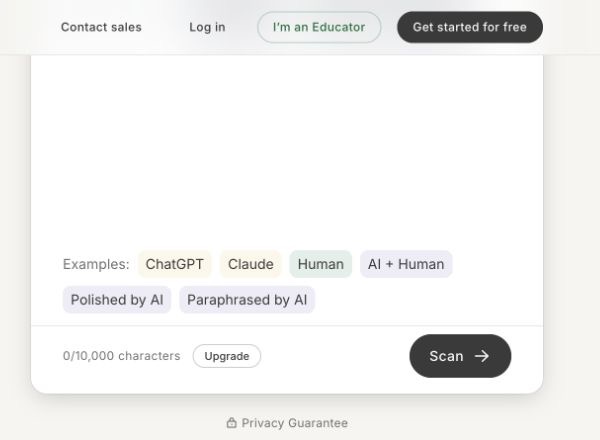
GPTZero's public detector interface showing the text area, input boundary, and Scan button.
GPTZero explicitly says that no AI detector is 100% accurate and that results should not be used as a final verdict. It also says longer English prose produces stronger evidence than short text. Its pricing page and overage guidance describe plan-dependent usage and billing, so verify the current allowance before using it at scale.
Turnitin for institutional review
Turnitin's AI Writing Report is designed for a different setting. Turnitin says the feature must be added to an institution's license through its account manager, and instructors or users must work with their administrator to access it. It is not an anonymous public detector that an individual can configure to reproduce an institution's setup.
Its report guide says the AI-writing percentage covers qualifying prose the model identifies as likely AI-generated or AI-modified. That score is separate from the Similarity score. A source-overlap report and an AI-writing signal answer different questions, so neither should be used as a shortcut for the other.
Turnitin also documents boundaries that matter in practice: an AI Writing Report requires 300 to 30,000 words of qualifying long-form prose, a supported language, an eligible file type, and a file under 100 MB. Its score-access guide suppresses exact scores and highlights from 1% through 19% because false positives are more likely in that range.
Most importantly, Turnitin says the model should not be the sole basis for adverse action. Human scrutiny and the institution's academic policies remain necessary. Its access documentation explains that availability depends on an enabled institutional license and administrator access.
How to use either result responsibly
Start with the result as a question, not a conclusion. Ask whether the text is complete, accurate, and appropriate for its purpose. Look at the author's sources, version history, assignment or workplace context, and any explanations or drafts that are already available. Follow the process your school or organization has established before making a consequential decision.
Do not treat a high score as proof of wrongdoing or a low score as proof that no assistance was used. A proportionate review is more reliable and fairer than a conclusion drawn from a percentage alone.
FAQ
Review the writing before acting
For a separate, non-conclusive screening signal on a longer passage, use Rephrase AI and follow it with human review.