Copyleaks vs ZeroGPT vs GPTZero: Three Detectors Compared
Compare Copyleaks, ZeroGPT, and GPTZero by access, input limits, reporting workflows, integrations, and responsible review guidance.

There is no supported overall accuracy winner among Copyleaks, ZeroGPT, and GPTZero. Copyleaks is the strongest fit when platform integrations and multilingual detection matter. ZeroGPT fits a straightforward public scan with file upload and report-oriented features. GPTZero fits a review that benefits from writing replay, connected workflows, and explicit provider cautions. Treat every result as a prompt for review, not proof of authorship.
The same criteria apply to all three products: public or account access, documented input boundaries, reporting and review features, integrations or connected workflows, and how responsibly a result can be interpreted.
Copyleaks vs ZeroGPT vs GPTZero at a glance
| Decision point | Copyleaks | ZeroGPT | GPTZero |
|---|---|---|---|
| Access | Public scan plus account and platform workflows | Public detector plus plan-dependent report and batch features | Public detector plus signed-in web workflows |
| Documented public boundary | Up to 25,000 characters on the anonymous pasted-text surface; other limits vary by surface | 15,000-character counter and file upload on the public page | 10,000-character limit and 250-character minimum on the anonymous detector |
| Review features | Public score with account-enabled sentence and pattern detail | Percentage, sentence highlighting, reports, and batch upload depending on feature access | Percentage, phrase highlighting, paid reports, and writing replay |
| Connected workflow | API, LMS, browser extension, and Google Docs options | Organization API | Chrome, Google Docs, Google Classroom, Canvas, Zapier, and API |
| Best fit | Teams needing documented language and platform options | Readers prioritizing a simple public input and report workflow | Readers wanting process context and connected education or browser workflows |
Copyleaks: platform reach and multilingual review
Copyleaks' AI Detector documents several access paths rather than one universal limit. Its anonymous pasted-text surface accepts up to 25,000 characters, while its browser-extension detector has a 350-character minimum. The web platform separately lists a 255-character minimum and a maximum of 2,000 pages.
The public score is only the first layer. Copyleaks says a free account adds sentence-level insights, highlighted phrases, and pattern breakdowns. It also documents API, LMS, browser-extension, and Google Docs integrations, which can make the product a practical fit when review needs to sit inside a wider platform workflow.
Its language documentation lists 30 AI-detection languages and automatic language detection. That makes Copyleaks the clearest fit of these three when language coverage and integrations drive the decision. Its output still needs human interpretation alongside the source, drafting context, and applicable policy.
ZeroGPT: public input and report-oriented features
ZeroGPT's public detector displays a 15,000-character counter and an Upload File control. That visible allowance is useful when a reader wants to screen a longer pasted passage without first choosing a broader platform workflow.
The product page also documents percentage output, sentence highlighting, generated PDF reports, and batch file upload, with some features presented as premium. Its pricing page describes an organization API for the detector and other writing tools.
ZeroGPT is the best fit here when a simple public entry point, file upload, and report-oriented options matter most. Its percentage and highlights remain non-conclusive signals. Review the text's sources, history, context, and relevant policy before reaching a decision.
GPTZero: writing context and connected workflows
GPTZero's public detector documents a 10,000-character limit and a 250-character minimum. The product separates its percentage and phrase highlights from paid downloadable reports and writing replay, giving reviewers more than one type of context to consider.
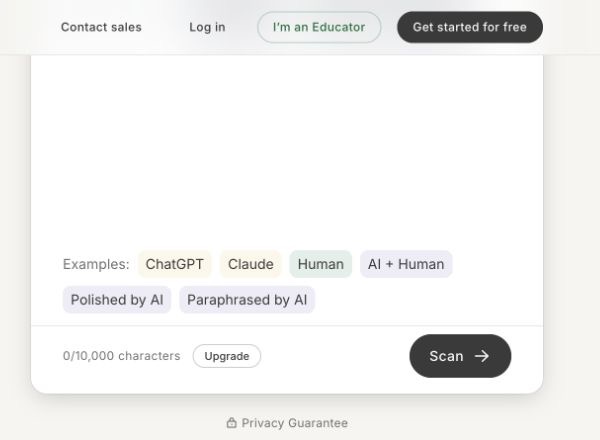
GPTZero's public detector interface showing the text area, input boundary, and Scan button.
GPTZero also lists Chrome, Google Docs, Google Classroom, Canvas, Zapier, and API integrations. Those connections make it the strongest fit of the three when the review belongs inside an education, document, or browser workflow and writing replay can add process context.
The provider says no AI detector is 100% accurate, results should not serve as a final verdict, and longer English prose provides stronger evidence than short text. Check GPTZero's pricing page and overage guidance before using it regularly, because plan usage and extra-word billing affect the operating cost.
Which detector fits your review?
Choose Copyleaks when documented platform integrations, account-enabled detail, or broad language coverage is central to the workflow. Choose ZeroGPT when you want a direct public scan with file upload and report-oriented product features. Choose GPTZero when writing replay, education and browser integrations, or explicit interpretation guidance matters most.
No choice removes the need for human review. Consider source material, drafting or version history, the writer's explanation, the assignment or workplace context, and the policy that applies. A detector score can identify a question to investigate; it cannot settle authorship on its own.
FAQ
Add a separate review signal
For another non-conclusive screen on text you are responsible for reviewing, use Rephrase AI's AI detector, then check the result against the writing's sources and context.