Walter Writes AI vs Turnitin: Which Detector Workflow Fits?
Compare Walter Writes AI and Turnitin by detector purpose, access, report boundaries, platform context, and responsible review.

Walter Writes AI is the more accessible choice for an individual who wants a detector available across web, browser, and mobile surfaces. Turnitin is the better fit for schools that already license and administer its academic AI Writing Report. Neither product's score proves authorship, plagiarism, or misconduct.
The same criteria apply to both products: detector purpose, user access, input and report boundaries, platform context, and the human or policy review required before a consequential decision.
Walter Writes AI vs Turnitin at a glance
| Decision point | Walter Writes AI | Turnitin |
|---|---|---|
| Access | No-card trial with three days of AI Detector access | Institutional license and administrator enablement |
| Detector purpose | Estimate AI likelihood and present an authenticity score | Review qualifying prose for AI-writing signals inside a licensed academic workflow |
| Product context | Detector beside a separate humanizer workflow | AI Writing Report beside a separate Similarity score |
| Platforms | Web application, Chrome extension, iOS, and Android | Licensed Turnitin products in institution-managed workflows |
| Best fit | Individual, cross-platform screening | Governed academic review under institutional policy |
Walter Writes AI for cross-platform screening
Walter Writes AI describes its public detector as estimating AI likelihood and presents an authenticity-score workflow beside a separate humanizer. A score is still a screening signal, not a record of who wrote the text.
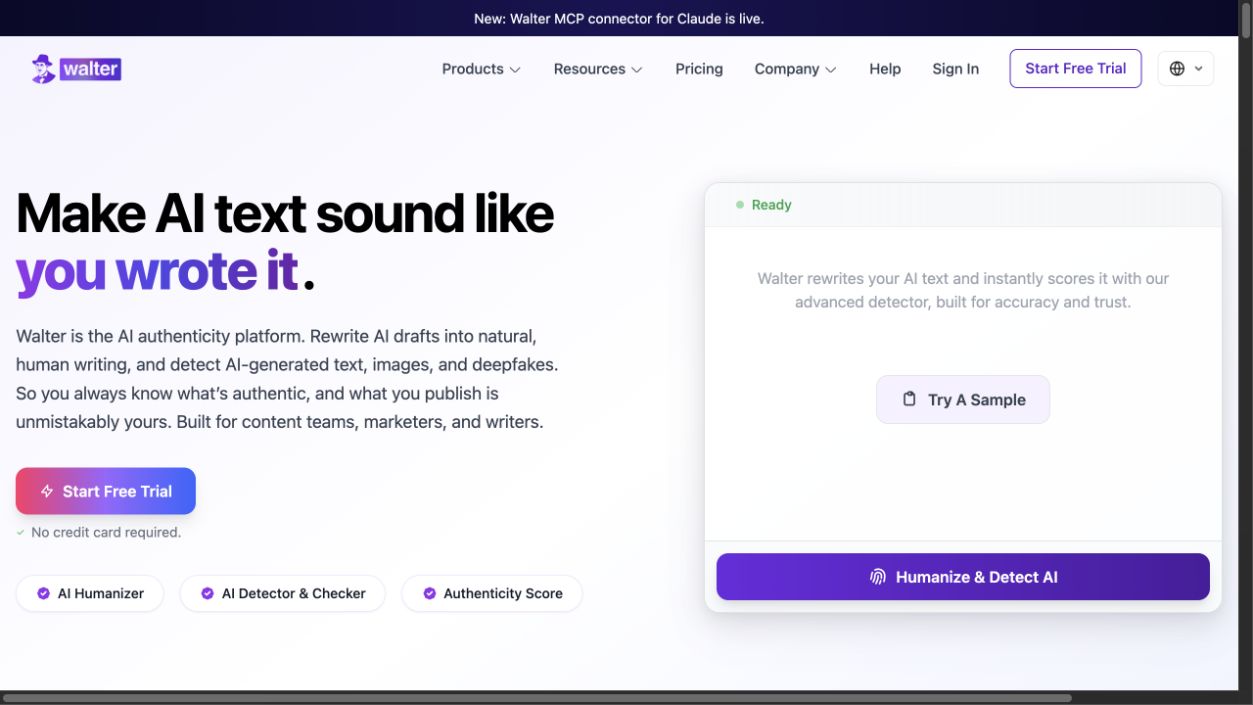
Walter Writes AI's public page shows its detector and humanizer entry points alongside free-trial controls.
Walter's trial guide documents a no-card trial with 300 humanizer words and three days of AI Detector access. Its pricing page publishes plan-specific monthly word allowances on annual plans, per-request word limits, and built-in detector access.
The mobile page documents synchronized access across the web application, Chrome extension, iOS app, and Android app. Choose Walter when individual access across those surfaces matters. Keep its detector and humanizer purposes separate: changing wording does not change the truth of who authored a passage or guarantee a detector outcome.
Turnitin for institutionally governed review
Turnitin's access guidance says AI Writing Detection must be added to an institution's license and managed through its administrator. It is not a public individual product.
The AI Writing Report guide requires 300 to 30,000 words of qualifying long-form prose, a supported language, an eligible DOCX, PDF, TXT, or RTF file, and a file below 100 MB. Its percentage is independent of Similarity and may misidentify human or AI text.
Turnitin's report-access guide suppresses exact scores and highlights from 1% through 19%, where false positives are more likely. That rule is a caution about interpretation, not an accuracy threshold. Turnitin says the model must not be the sole basis for adverse action.
Why this is not a humanizer test
The products should be compared on their documented detector workflows, not on a claim that rewriting produces a desired score. Walter offers a humanizer beside its detector, but those are separate actions with separate purposes. Turnitin evaluates qualifying submissions within an institutional process; it does not certify the quality of a rewrite.
For either detector, do not infer human authorship from a percentage. Human review should consider source material, drafting history, the writer's explanation, context, and the policy that governs the work.
Which detector workflow fits?
Choose Walter Writes AI when an individual needs a cross-platform detector and understands that the output is a likelihood signal. Choose Turnitin when a school already licenses and administers its report and can apply institutional policy.
The products' scores should not be treated as interchangeable. Access, qualifying inputs, report behavior, and review context differ, so the practical choice begins with the workflow rather than a promised outcome.
FAQ
Add a separate, non-conclusive signal
For text you are responsible for reviewing, try Rephrase AI's AI Detector, then interpret its likelihood signal alongside sources, context, and policy.