ZeroGPT vs GPTZero: Not the Same Tool
Compare ZeroGPT and GPTZero by documented detector workflows, input limits, reports, integrations, and responsible review guidance.

ZeroGPT and GPTZero are separate detector products with different input, reporting, and integration workflows. Neither can prove who wrote a document. Choose between them by the review surface you need, the limits that fit your text, and the other evidence available—not by treating one score as an authorship verdict.
At a glance
| Product | Best fit |
|---|---|
| ZeroGPT | A reader who needs a public detector with a larger documented character counter and report-oriented product features. |
| GPTZero | A reader who values documented highlighting, writing replay, and integrations alongside an explicit warning against final-verdict use. |
ZeroGPT: larger public input and report features
ZeroGPT's public detector page documents a 15,000-character counter and an Upload File control. The same official page describes sentence highlighting, percentage output, PDF reports, and batch uploads, although some of those features are presented as premium capabilities. Its pricing page also describes organization API access.
That can make ZeroGPT a practical option when the visible input allowance and report workflow matter more than a particular browser extension or learning-platform connection. Confirm the plan-specific availability of reporting and batch features before adopting it for a recurring process.
ZeroGPT's documented workflow does not establish an overall accuracy advantage over GPTZero. Treat its percentage as a review signal and judge it with the source material, drafting history, and policy that apply to the document.
GPTZero: detector context and connected workflows
GPTZero's public detector documents a 10,000-character anonymous limit and a 250-character minimum. It also describes percentage results, phrase highlighting, paid downloadable reports, and writing replay as different review features. Its listed integrations include Chrome, Google Docs, Google Classroom, Canvas, Zapier, and an API.
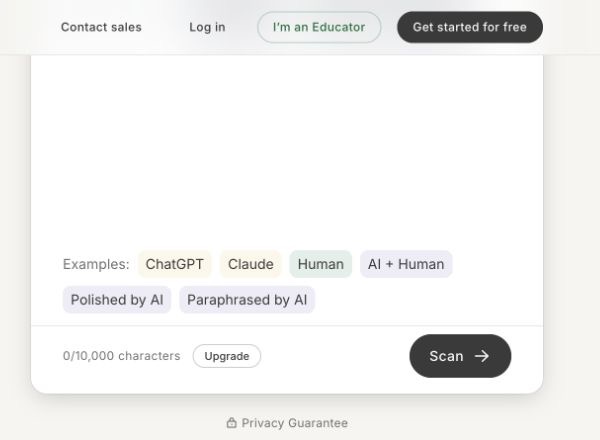
GPTZero's public detector interface showing the text area, input boundary, and Scan button.
GPTZero is the clearer choice when your review process needs those connected workflows or when writing-process context matters alongside a detector reading. The company also says that no AI detector is 100% accurate, that results should not be a final verdict, and that longer English prose provides stronger evidence than short text. Its pricing page and overage guidance should be checked for current plan and word-use terms.
The interface makes the scanning workflow clear, but the product's percentage should still be interpreted with the surrounding writing context rather than treated as a measure of authorship.
What should guide your choice?
Pick ZeroGPT when its documented public input size, upload path, and report features match the review task. Pick GPTZero when writing replay or its listed education and browser integrations are a meaningful part of the context you need to collect.
For either tool, keep the detector result in proportion. Review sources, drafting history, assignment or workplace context, and any policy that applies. A high or low percentage is a signal to investigate, not proof of human or AI authorship.
FAQ
Review the writing, not just the score
For a second review signal on a text you own, use Rephrase AI's AI detector as a prompt to check facts, sources, specificity, and context rather than as a verdict.